
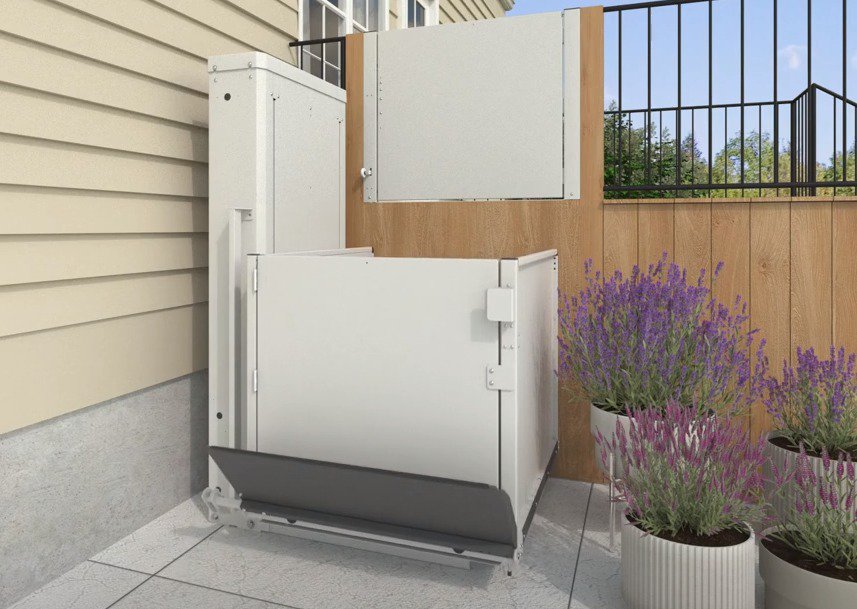
For many New Jersey families and small businesses, a vertical platform lift (VPL) is the most space-smart, cost-effective way to get wheelchair users over a short rise — porch steps, garage landings, split-level entries, and small stoops — without the time and expense of a full elevator. This short guide explains how VPLs work, who they help, the types that work best for homes and light-commercial sites, and what to check before you buy in Absecon, Hillsborough, and across New Jersey.
What is a vertical platform lift and who needs one?
A VPL is a sturdy, open platform that travels straight up and down to move a wheelchair user and their mobility device safely between levels. Compared with ramps, VPLs need far less footprint. Compared with elevators, they install faster and usually cost less. That makes them ideal for homes where doorway thresholds, porches, and raised entries create daily barriers, and for storefronts, clinics, and community buildings that need ADA-compliant access without major construction.
How VPLs improve mobility
- Independence: Users can enter and exit without help.
- Space savings: Much shorter than long exterior ramps.
- Weather-tough options: Outdoor-rated models that stand up to coastal conditions.
- Smooth performance: Built for scooters, power chairs, and manual wheelchairs.
If the main obstacle is a full stair flight inside the home, a stairlift such as a Bruno chair lift pairs well with a VPL. Use the VPL for short external rises and the stairlift for full interior stair coverage.
Types of vertical platform lifts
- Porch & garage VPLs — Outdoor-rated, gated platforms with non-skid decks and simple controls.
- Enclosed or tower VPLs — Add protection and privacy for frequent outdoor use or longer rises.
- Hybrid/indoor platforms — Quiet, compact units designed to fit finished interiors.
Residential wheelchair lift installation checklist
- Measure the site — Rise height, clear platform area, and approach/exit paths.
- Confirm power — Verify electrical supply and any dedicated circuits required.
- Prepare the base — Concrete pad or structural base must meet manufacturer specs.
- Pick safety features — Gated access, interlocks, emergency lowering, keyed controls, and anti-slip decking.
- Permits and code — Local approvals vary by township. Experienced installers handle permit paperwork and inspections.
- Service plan — Schedule annual maintenance and coastal-condition checkups if you are near the shore.
Quick benefits at a glance
- Independence and dignity for users
- Far less space than ramps
- Faster, lower-cost installation than an elevator
- Works for homes, small businesses, schools, and faith centers
- Supports aging-in-place planning and property accessibility upgrades
Why Mobility123
We handle VPL projects in-house from site survey to final inspection, with licensed elevator mechanics and skilled carpenters who know New Jersey permitting, HOA rules, and shore-area weather challenges. Local experience means we size the correct unit, prepare the pad and electrical work properly, and offer service plans that keep your lift running year-round. We also design solutions that combine VPLs and stairlifts, so you only pay for what you’ll use every day.
Ready to reclaim safe entry?
For tailored recommendations and on-site evaluations of residential and light-commercial platform lifts in Absecon, Hillsborough, and across New Jersey, contact Mobility123 to schedule a consultation.
FAQs
Most residential installs finish in a few days once permits and the base are ready. Timelines vary by model, enclosure needs, and local approval times.
Yes. Outdoor-rated units use corrosion-resistant materials and weatherproof controls. Ask about maintenance plans for coastal conditions.
A VPL carries a wheelchair and user vertically over a short rise like porch steps. A stairlift carries a seated rider along a stair flight. Both solve different problems and can be used together for full access.
