

You have decided a wheelchair lift is the right way to get into your home, or between its levels. Then you start shopping. Prices range from low “kit” prices online to much higher installed quotes from local dealers, and it is hard to tell why.
The short answer: a wheelchair lift is not an appliance. It is a regulated safety device. Its price covers the lift, the safety equipment the standard requires, the site work that holds it up, the wiring, the permit and installation by a licensed elevator mechanic. This article explains each of those costs, so you can compare quotes on equal terms.
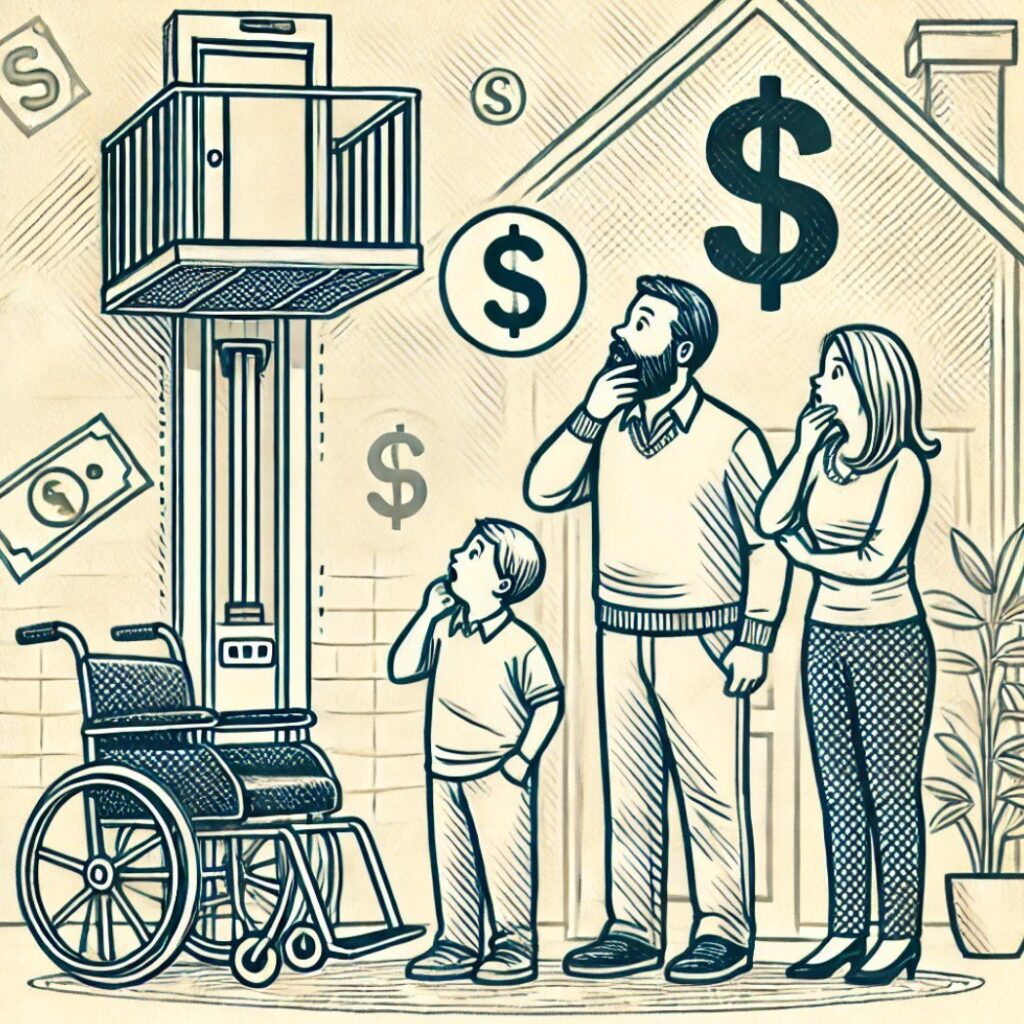
Two Types of Wheelchair Lift
A wheelchair lift carries a person on a platform, so they stay in their wheelchair for the ride. There are two main types.
Vertical Platform Lift (VPL)
The platform goes straight up and down between levels. It does not ride on the stairs. A VPL often serves a porch, a deck, a garage entry or a split-level floor. Some models are open. Others come with an enclosure or their own shaft.
Inclined Platform Lift (IPL)
The platform rides on rails that follow a staircase. Some models serve one straight flight. Others follow stairs that turn, have landings or serve several levels.
A stairlift is different. On a stairlift, the rider moves from the wheelchair to a seat. On a platform lift, the rider stays in the wheelchair.
To compare the wheelchair lifts we sell, see the wheelchair lift planning guides on elevatorguide.com.
What Drives the Cost of a Wheelchair Lift
Every home is different, but the same six things set the price of every wheelchair lift project.
1. The Type of Lift and How Far It Travels
A short, open lift beside a porch is a smaller project than an enclosed lift between floors. The travel height, the number of stops, the platform size and the way a wheelchair rolls on and off all change the model and the price.
Inclined lifts add one more factor: the rail is made for your stair. Savaria, for example, custom designs the guide rail for each site, and builds its curved-stair lift at the factory for a left-side or right-side rail.
2. The Safety Equipment the Standard Requires
In New Jersey and Pennsylvania, wheelchair lifts fall under ASME A18.1, the national safety standard for platform lifts and stairway chairlifts. The manufacturers’ documents list safety features such as:
- Gate and door interlocks, so the lift does not move unless every gate is closed
- Obstruction sensors and a safety pan under the platform, which stop the lift if something is in the way
- An emergency stop and an alarm
- A way to lower the platform in a power outage, such as battery lowering or a manual crank
- On inclined lifts: safety arms, platform ramps, edge sensors and an overspeed brake
These are not optional extras. They make the lift safe to use, and they are a large part of what you pay for. For more, see Wheelchair Lift (VPL) Safety Features.
3. Site and Structural Work
A lift is only as safe as what holds it up. Depending on the model and your home, the project may need:
- Concrete pad or slab: Bruno notes that a platform lift must rest on concrete, so a pad may need to be poured. A sidewalk may also be needed for the approach path.
- Pit or ramp: Many vertical lifts need a shallow pit or a ramp at the bottom, so a wheelchair can roll on. An outdoor pit needs a way to drain water.
- Wall and stair support: Some lift towers and most inclined lift rails fasten to the building. For inclined lifts, Savaria says a qualified professional must make sure the building and stairway safely support all loads.
- Gates and enclosures: The top landing needs a gate or door on strong framing. Savaria notes that the safety code does not allow a vertical platform lift to pass through a floor on its own, so a lift between floors needs a shaft or a factory enclosure.
- Finish work: Masonry, carpentry, drywall, patching and painting around the lift.
Plan this work early. Reinforcing a wall after it is finished means opening it up.
4. Electrical Work
A wheelchair lift needs its own circuit, sized for the model. Some lifts run on a standard 120-volt circuit. Others need a 208- to 240-volt supply, which is a different circuit. An enclosed lift can also need a disconnect switch, lighting, an outlet and a phone line or two-way communication. An electrician runs this work.
5. Options for Your Home and Climate
Enclosures, glass or acrylic panels, automatic door operators, extra stops and custom colors all change the price. Outdoor lifts may need weather-resistant finishes and locks, corrosion-resistant parts, a roof or canopy, or a cold-weather package, depending on the brand. Some inclined lifts are rated for outdoor use in moderate climates only.
6. Permits, Plans and Licensed Installation
In New Jersey, a wheelchair lift needs a construction permit and must be installed by a licensed elevator mechanic. Depending on who reviews the project, it can also need sealed drawings and a sealed report from a licensed engineer or architect. A kit price leaves all of this out. The permit section below explains the steps.
Maintenance and Warranty
A lift needs regular maintenance to stay safe and reliable. Manufacturers also set conditions on their warranties:
- Savaria: The limited warranty covers parts, not labor. The lift must be bought, installed and maintained by an authorized Savaria dealer.
- Cibes Symmetry: The warranty covers parts only. It requires installation by an authorized dealer and regular maintenance.
- Bruno: The warranty covers labor by an authorized Bruno dealer for a short time after installation, and not after that.
Read the warranty before you buy, and ask who will service the lift. Mobility123 offers annual VPL maintenance plans.
Why a Low Online Price Rarely Covers the Whole Job
An online listing usually shows the price of the lift alone. It rarely includes:
- Site work: concrete, a pit or ramp, wall support, gates and finish work
- Electrical work
- The permit, the drawings and any sealed report
- Installation by a licensed elevator mechanic, which New Jersey requires
- Service and repairs after installation
- A valid warranty, when the manufacturer requires an authorized dealer to sell, install and maintain the lift
Add those costs back, and the low price often is not low anymore. A lift that is installed wrong, or that cannot pass its permit, can cost more to fix than to do right the first time.
Permits and Approvals in New Jersey and Pennsylvania
New Jersey
New Jersey treats a wheelchair lift as an “elevator device” under its Elevator Safety Subcode. That means:
- Permit: A construction permit is required before installation. It has sections for the building, electrical and elevator work.
- Installer: A licensed elevator mechanic, or a person working under one, must install the lift, including in a private home. The permit application lists the mechanic’s license number.
- Acceptance: The lift must be accepted before it goes into service. In a private home where the state (DCA) is the elevator subcode official, a New Jersey licensed engineer or registered architect submits a sealed report, at the applicant’s expense. Where a local or third-party office handles the elevator work, ask that office how acceptance works.
- Inspections: A lift in a private home that is not open to the public is exempt from periodic inspection and registration. Wheelchair lifts in other buildings must be inspected and tested at least once a year.
- Local approvals: Your town may need other approvals, such as a zoning review for an outdoor lift.
Pennsylvania
Pennsylvania’s Uniform Construction Code does not apply to a lift used only by the occupants of one dwelling unit in a solely residential building. In other buildings, the Department of Labor and Industry permits and inspects wheelchair lifts.
Pennsylvania’s construction code sets no statewide elevator mechanic license, but local contractor licensing can apply, for example in Philadelphia.
Learn More
For the full rules and their sources, see these pages:
- Elevator and Lift Codes in NJ and PA on elevatorguide.com
- How New Jersey permits and plan review work
- Acceptance for a lift in a private home
- What applies in Pennsylvania
- Our post on the New Jersey elevator permit process
How Mobility123 Handles a Wheelchair Lift Project
Mobility123 sells, installs and services wheelchair lifts in New Jersey and eastern Pennsylvania. Our team includes New Jersey licensed elevator mechanics and an in-house construction team, so one company can manage the project from start to finish.
- Permits: We prepare and submit the permit application, work with the code office on inspections and acceptance, and handle any corrections it asks for.
- Brands: We are authorized to sell and service Savaria, Bruno and Cibes Symmetry wheelchair lifts.
- Written quote: Your quote lists the lift, the installation, the permit work and any construction we will do, so you can see what you are paying for.
- Service: Our technicians maintain and repair the lifts we install, and we offer annual VPL maintenance plans.
Learn more about the benefits of a turn-key accessibility partner.
Plan With the Manufacturer’s Facts on elevatorguide.com
Before you collect quotes, look up the lift on elevatorguide.com, Mobility123’s free planning site. It has a guide for every wheelchair lift we sell. Each guide takes its facts from the manufacturer’s current documents and names its sources. It covers the site work, the electrical circuit, the code steps in New Jersey and Pennsylvania, who does what, common planning mistakes and the manufacturer’s published warranty.
| Planning guide | Lift type |
|---|---|
| Bruno VPL-3100 and VPL-3200 Series | Vertical: open, two stops |
| Cibes Symmetry VPL | Vertical: open, enclosed or in a shaft |
| Cibes Primo and Cibes Air | Vertical: comes with its own shaft |
| Savaria Multilift | Vertical: open, enclosed or mobile |
| Savaria V-1504 | Vertical: open or enclosed |
| Savaria Delta | Inclined: one straight flight of stairs |
| Savaria Pegasus | Inclined: stairs that turn, have landings or serve several levels |
Bring the guide to your quote meeting. It makes it easier to compare sellers on the same model and the same scope of work.
5 Questions to Ask Any Wheelchair Lift Seller
Whoever you buy from, ask these questions. Clear answers are a good sign. Vague answers are a warning.
1. What will it cost to install, permit and approve this lift at my home?
Ask what the price includes: site work, electrical work, the permit, any drawings or sealed report, and installation. The price of the lift alone does not tell you the cost of the project.
2. Who will install the lift, and are they licensed?
In New Jersey, a licensed elevator mechanic, or a person working under one, must install a wheelchair lift, including in a private home. Ask for the license number. See who may install elevators and lifts in New Jersey.
3. Who will handle the permit and the acceptance steps?
The answer should name who files the permit, who arranges any drawings or sealed report, and who works with the code office.
4. Which brand and model do you recommend for my home?
Ask for the exact model, then look up its specifications and safety features in the wheelchair lift guides on elevatorguide.com. Compare the same model across quotes. Generic descriptions make a fair comparison impossible.
5. What does the warranty cover, and who will service the lift?
Many manufacturer warranties cover parts only and require an authorized dealer to install and maintain the lift. Ask who will do that work near you.
An Investment in Independence
A wheelchair lift is a big purchase. Its price reflects a regulated safety device, the work to support it and the licensed people who install it. When you compare quotes on the full scope of work, the real differences between sellers become clear.
Ready to talk about your home? Contact Mobility123, or call or text (609) 385-9575, for a free consultation.
