
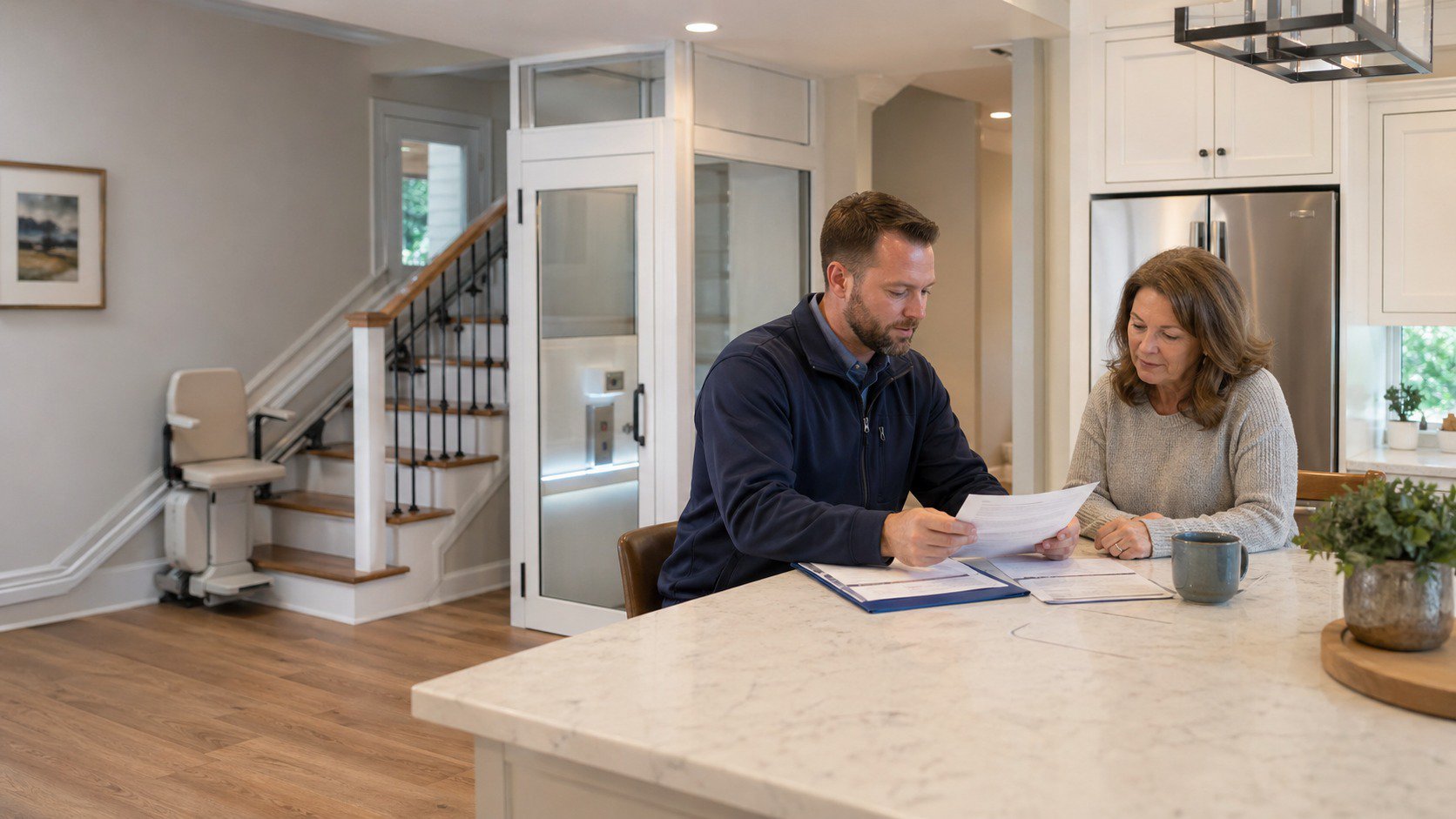
If you've ever started gathering quotes for a stairlift, home elevator, or accessible bathroom remodel, you've probably had a moment where the contractor's professionalism either reassured you or set off a quiet alarm. One of the clearest signals you can ask for is something most homeowners have never heard of: a Certificate of Insurance, often paired with what's called an Additional Insured endorsement. At Mobility123, we provide these documents as a routine part of every project. Here's what they are, why they matter, and what every New Jersey homeowner should expect from any accessibility contractor working in their home.

Why Insurance Documentation Matters More for an Accessibility Install
Many of our customers reach out after a fall, a new diagnosis, or a difficult family conversation about an aging parent. The last thing you should have to worry about during a window like that is whether the people walking in and out of your home are properly protected if something goes wrong.
Accessibility installations involve real risks that don't apply to most home projects: heavy equipment carried up flights of stairs, electrical work for elevator and homelift power, structural anchoring of stairlift rails and platform lift towers, and crews moving freely through occupied homes that often include older adults or family members with mobility challenges. Proper insurance documentation is what separates a contractor set up to handle that risk from one who simply hopes nothing goes wrong.
The Three Insurance Terms Every Homeowner Should Know
Insurance has its own vocabulary, and three terms in particular get used interchangeably even though they mean very different things. Understanding the distinctions protects you.
Policyholder (Named Insured)
The policyholder is the company that actually bought the policy and pays the premium. On any Mobility123 project, that's us. We're the named insured on our commercial general liability policy and our workers' compensation policy.
Certificate Holder
A Certificate Holder is a third party who receives a copy of the Certificate of Insurance. That's it. Being a Certificate Holder gives you proof that the contractor has insurance, but it does not give you any rights to make a claim under that policy. If something goes wrong on your project, a Certificate Holder cannot file against the contractor's insurance. They can only point to the certificate and say, in effect, 'they had coverage.'
Additional Insured
An Additional Insured is a person or entity who has actually been added to the policy and is genuinely covered under it. Unlike a Certificate Holder, an Additional Insured has the right to file a claim if a covered loss happens during the project. If a worker is injured on your property and the worker's family sues you as the property owner, your status as an Additional Insured means you can turn to the contractor's policy for defense, rather than relying on your own homeowners insurance or paying out of pocket.
This is the distinction most homeowners miss. A Certificate Holder has paper. An Additional Insured has protection.
The Difference Between a Certificate and an Endorsement (and Why You Want Both)
Even within the Additional Insured side of that distinction, there's a second nuance that catches even experienced buyers off guard. A Certificate of Insurance, often called an ACORD 25 form, is a one-page summary of a contractor's coverage. The actual Additional Insured protection is not conferred by the certificate itself. It is conferred by a separate policy endorsement, typically using ISO form CG 20 10 (which covers ongoing operations while the work is in progress) or CG 20 37 (which covers completed operations after the install is finished, so a problem that surfaces later is still covered).
In other words, the Certificate of Insurance shows that coverage exists. The endorsement is what actually grants you protection under it. A homeowner who only receives a Certificate with the Additional Insured box checked, without a copy of the underlying endorsement, may not have the protection they think they have.
When Mobility123 issues these documents:
- For commercial projects, condominium associations, and homeowner association installations, we issue both the Certificate of Insurance and the Additional Insured endorsement automatically.
- For residential projects, we issue the Certificate of Insurance as standard practice and add the Additional Insured endorsement on request, usually within 24 to 48 hours.
- There is no charge to our customers for either document.
New Jersey's Updated Contractor Insurance Requirements (As of 2026)
A meaningful part of the reason Mobility123 has these documents readily available is that New Jersey has tightened its standards substantially. In 2024, the state passed P.L. 2023, c. 237, which amended the Contractors' Business Registration Act and created the New Jersey State Board of Home Improvement and Home Elevation Contractors. Today, every Home Improvement Contractor Business operating in NJ must carry:
- A minimum of $500,000 per occurrence in commercial general liability insurance
- Workers' compensation insurance, unless the business legally qualifies for an exemption
- A compliance bond, irrevocable letter of credit, or other state-approved financial security
- Annual registration with the NJ Division of Consumer Affairs Home Improvement Contractor program
For Home Elevation Contractor Businesses, the general liability minimum jumps to $1,000,000 per occurrence, reflecting the catastrophic risk of structural lifting work.
Mobility123 carries $1,000,000 per occurrence in general liability coverage, which is the industry standard for professional accessibility contractors and twice the state minimum for home improvement work. Our NJ Home Improvement Contractor registration number is 13VH06391700, and you can verify it directly through the NJ Division of Consumer Affairs license verification system at any time. A registration that comes back as expired, suspended, or 'not found' is one of the strongest signals that you should walk away from a contractor.
Why Accessibility Projects Carry Different Risk Than General Home Improvement
This is one of the under-appreciated reasons we built our business around in-house W-2 employees rather than the subcontractor model that's common in home improvement. Mobility123 currently has roughly 45 W-2 employees and only a handful of contracted specialists. Most of our competitors run primarily on subcontractors.
The reason that matters for you: when a contractor uses subs, every single sub needs their own independent insurance, their own workers' compensation coverage, and (as of 2024) their own NJ HIC registration. Verifying all of that on every sub for every project is functionally impossible for a homeowner. When something goes wrong, it can take weeks to figure out whose insurance is supposed to respond, and gaps show up in places nobody anticipated.
When the people in your home are direct Mobility123 employees, they're covered by our commercial general liability policy, our workers' compensation policy, and our auto policy as a single chain of coverage. The Additional Insured endorsement we issue applies to everyone on the job because everyone on the job is on our payroll.
The work itself also genuinely carries elevated risk compared to a typical home improvement project:
- Elevator and homelift installations involve electrical service work and shaft construction
- Stairlift installations require structural anchoring into stair stringers and load-bearing wall framing
- Platform lifts involve permanent foundations and dedicated electrical service
- Crews are routinely moving heavy equipment through occupied homes, often around residents with limited mobility
Whether you're installing a Stiltz homelift, a Savaria Vuelift, a Bruno or Harmar stairlift, or a Cibes platform lift, the underlying work touches more systems in your home than a typical project does. That's a meaningful argument for verifying coverage carefully. Our comparison guide to home elevators, homelifts, wheelchair lifts, and stairlifts walks through how each of these systems is installed if you want to understand the scope of work involved.
What to Ask Every NJ Accessibility Contractor (Including Us)
Use this checklist on any accessibility contractor you're considering, ours included:
- Provide a current Certificate of Insurance dated within the policy period that covers your project window.
- Show commercial general liability coverage of at least $500,000 per occurrence, with $1,000,000 being the industry standard for accessibility work.
- Confirm workers' compensation coverage, since this is what protects you if a worker is injured on your property.
- Add you as an Additional Insured with the actual endorsement form attached, not just the box checked on the certificate.
- Provide their NJ Home Improvement Contractor registration number, which you can verify on the state license system.
- Identify whether subcontractors will be on site, and provide insurance and registration documents for each one.
- Issue the certificate to the correct legal entity name and the actual install address, since carriers sometimes default to the contractor's business address.
If a contractor pushes back, stalls, or charges a fee for any of this, that's information about how they'll handle the rest of your project.
How Mobility123 Handles This as Standard Practice
By the time you're ready to schedule an install with us, the insurance side has already been worked out:
- Our office team has the Certificate of Insurance request form on file from day one of any commercial or HOA project, and turnaround for any homeowner request is 24 to 48 hours.
- The Certificate is issued under our legal entity, DSI, DBA Mobility123.
- For HOA, condominium, and commercial projects, the Additional Insured endorsement is included automatically.
- For residential projects, the endorsement is available at no charge whenever a homeowner, financial advisor, or association requests it.
- All work is performed by Mobility123 W-2 employees covered under our policies, including our state-licensed elevator mechanics for elevator and lift installs.
- Our ongoing maintenance plans carry the same insurance protections, so the relationship doesn't end at install.
This isn't a marketing differentiator we invented for this article. It's something most of our customers never even ask about, because it's just how we run the business.
What to Do if You've Already Hired a Contractor Who Can't Produce These Documents
If you've already signed a contract or paid a deposit and the contractor has been vague about insurance, you have options:
- Request the documents in writing. A legitimate contractor with active insurance can produce a Certificate of Insurance within a business day.
- Verify their registration on the NJ Division of Consumer Affairs license system.
- If they refuse, NJ law gives you grounds to cancel without losing your deposit in many cases. Document everything in writing.
- Contact the NJ Division of Consumer Affairs Office of Consumer Protection if you suspect fraud.
Asking a contractor for insurance documentation isn't being difficult. It's the same level of diligence you'd apply to any major financial decision. The legitimate contractors expect the question and answer it quickly.
Frequently Asked Questions
Do I need a Certificate of Insurance from my stairlift installer?
Yes. Any contractor working in your home should provide a current Certificate of Insurance if you request it. For accessibility installs in NJ, the certificate should show at least $500,000 per occurrence in commercial general liability coverage and active workers' compensation coverage, with $1,000,000 being the industry standard.
What's the difference between a Certificate Holder and an Additional Insured?
A Certificate Holder receives a copy of a contractor's Certificate of Insurance but has no rights to make a claim under that contractor's policy. An Additional Insured is actually added to the policy and can file a claim if a covered loss happens during the project. The first is paperwork; the second is real protection.
Does adding me as an Additional Insured cost extra?
At Mobility123, no. We do not charge customers for Certificates of Insurance or Additional Insured endorsements. Some carriers do charge contractors a small premium to add an Additional Insured, depending on the policy, but for our customers the documents are free.
How long does it take to get a Certificate of Insurance from Mobility123?
Within 24 to 72 hours of your request. For commercial, condominium, and HOA projects, the Certificate and Additional Insured endorsement are issued automatically as part of project setup, so you typically have them in hand before the install date is confirmed.
What should the Certificate of Insurance for my NJ accessibility project actually list?
The certificate should list the contractor's correct legal entity, the address where the work will take place (not just the business address), policy effective and expiration dates that cover your project window, the coverage amounts for general liability and workers' compensation at minimum, and your name as Certificate Holder, with Additional Insured noted in the appropriate field if you have requested that endorsement.
Talk to a Licensed, Fully Insured NJ Accessibility Contractor
Mobility123 has been New Jersey's full-service home accessibility specialist since 2003, with showrooms in Hillsborough and Absecon. Whether you're researching a stairlift for an aging parent, planning a home elevator, or designing an accessible bathroom remodel, we'll walk you through everything from product selection to permitting to insurance documentation, with no pressure and no hidden costs.
For South and Central New Jersey, call our Absecon office at (609) 385-9575.
For North New Jersey, call our Hillsborough office at (908) 498-7155.
Or schedule a free in-home assessment online and we'll come to you.
