
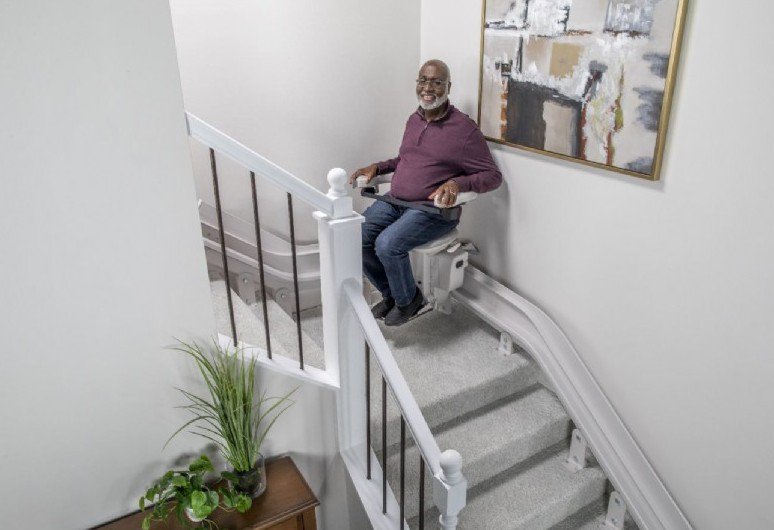
Your complete guide to stairlifts: costs, types, installation, and how to choose the right solution for your New Jersey home.
Key Takeaways
- Straight stairlifts cost $3,450–$6,000 installed; curved stairlifts range from $12,000–$18,000+ depending on configuration
- Installation takes just 2–6 hours and requires no structural modifications to your home
- Medicare doesn't cover stairlifts, but NJ Medicaid programs (like NJ FamilyCare) may provide up to $15,000 for home modifications
- Stairlifts run on battery power—they work during outages and can complete 10–20 trips without charging
- Choose a licensed, insured dealer with local service capability—not an online-only retailer
Table of Contents
- What Is a Stairlift?
- Who Should Consider a Stairlift?
- Types of Stairlifts (Straight, Curved, Outdoor)
- Stairlift Components and How They Work
- Key Features and Safety Options
- Stairlift vs. Home Elevator: Which Is Right for You?
- How Much Does a Stairlift Cost? (2026 Pricing Guide)
- New, Used, or Rental: Which Option Is Best?
- Paying for Your Stairlift (Medicare, VA, Medicaid, Financing)
- How to Choose a Stairlift Company
- The Stairlift Buying Process: What to Expect
- Installation: Timeline and What's Involved
- Warranties, Service, and Maintenance
- Frequently Asked Questions
- Why Choose Mobility123
1. What Is a Stairlift?
A stairlift is a motorized chair that travels along a rail mounted to your staircase, carrying you safely and comfortably between floors of your home. Sometimes called a stair chair, chair lift, or stair glide, this mobility device has helped millions of people maintain their independence and continue living in multi-story homes.
Every stairlift consists of three main components: a track or rail system that attaches to your stair treads, a chair unit equipped with a seat, armrests, and footrest, and a battery-powered motor that moves you smoothly up and down the stairs. The entire system is designed to be safe, quiet, and remarkably easy to use.
Stairlifts serve people who have difficulty climbing stairs due to age, injury, surgery recovery, or chronic health conditions like arthritis, COPD, or heart disease. Unlike home elevators, which require significant construction and dedicated shaft space, stairlifts don't require any structural modifications to your home. The rail mounts directly to your stair treads—not your walls—so installation is quick, clean, and completely reversible if you ever want to remove it.
Modern stairlifts are engineered to be compact and unobtrusive. When not in use, the seat, armrests, and footrest fold up against the wall, leaving plenty of room for other family members to walk up and down the stairs normally. Most units operate so quietly that you can carry on a conversation while riding.

2. Who Should Consider a Stairlift?
Stairlifts help a remarkably wide range of people maintain their independence, stay safely in their homes, and avoid the disruption and expense of moving to a single-story residence. You might benefit from a stairlift if you experience any of the following challenges:
Physical limitations that make stairs difficult:
- Pain, fatigue, or breathlessness when climbing stairs
- Arthritis in your knees, hips, or back that makes each step painful
- Balance issues or fear of falling on the stairs
- Heart or lung conditions that leave you winded after climbing
- General weakness or reduced stamina due to aging
Recovery from medical procedures:
- Hip replacement or knee replacement surgery
- Back surgery or spinal procedures
- Stroke recovery affecting mobility
- Any surgery that temporarily limits your ability to climb stairs safely
Caregiving situations:
- You're helping an aging parent who struggles with stairs
- You want to prevent a dangerous fall before it happens
- A family member's doctor has recommended they avoid stairs
The statistics underscore why stairlifts matter. According to the Centers for Disease Control and Prevention (CDC), falls are the leading cause of injury death among adults 65 and older, and stairs are one of the most common locations for dangerous falls in the home. At the same time, AARP research consistently shows that approximately 90% of seniors want to remain in their current homes as they age—a preference often called "aging in place."
A stairlift addresses both of these realities head-on. It dramatically reduces your risk of a stair-related fall while enabling you to stay in the home you love, surrounded by your community, neighbors, and memories.
Who is a good candidate for a stairlift?
Stairlifts are ideal for people who can sit down, stand up, and pivot with minimal assistance. You need to be able to transfer yourself onto the seat, remain seated during the ride, and step off at the other end. If you can do these things—even if stairs themselves have become too difficult or risky—a stairlift is likely a good solution.
When might a different solution be better?
If you use a wheelchair full-time and cannot transfer to a seat, a stairlift probably isn't the right choice. In these situations, a vertical platform lift (wheelchair lift) or home elevator may be more appropriate. Similarly, if multiple family members need to move between floors simultaneously, or if you need to transport heavy medical equipment, an elevator might serve you better.
A qualified mobility specialist can assess your specific situation and recommend the solution that best fits your needs, your home's layout, and your budget.
3. Types of Stairlifts
Stairlifts come in three main configurations, each designed for different staircase layouts and environments. Understanding these options will help you determine which type you need and what to expect in terms of cost and installation timeline.
Straight Stairlifts
Straight stairlifts are designed for staircases that travel directly from one floor to another without any turns, curves, intermediate landings, or changes in direction. If you can stand at the bottom of your stairs and see a clear, uninterrupted path to the top, you likely have a straight staircase.
Straight stairlifts are the most common and most affordable option. The rail is manufactured in standard lengths and cut to fit your specific staircase during installation. This standardization means straight stairlifts can often be installed the same day you order—or within just a few days. The typical installation takes only 2–3 hours from start to finish.
Because the rail doesn't require custom manufacturing, straight stairlifts offer the best value. Entry-level models start around $3,450 installed, with mid-range options in the $4,500–$6,000 range. Premium models with additional features or heavy-duty weight capacity may run $6,000–$8,000.

Best for: Single-flight staircases with no turns, curves, or landings
Installation time: 2–3 hours
Cost range: $3,450–$6,000 installed (new)
Lead time: Same-day to one week
Popular models: Bruno Elan, Bruno Elite, Access BDD HomegGlide
Curved Stairlifts
Curved stairlifts are custom-engineered for staircases with turns, curves, intermediate landings, spiral designs, or any configuration that isn't a simple straight shot. If your staircase changes direction at any point—whether it's a 90-degree turn at a landing, a sweeping curve, or a full spiral—you'll need a curved stairlift.
The key difference is the rail. While straight stairlift rails are standard products cut to length, curved stairlift rails must be precision-manufactured to match your exact staircase configuration. This process begins with detailed measurements of your stairs, typically captured using advanced photo measurement technology that ensures millimeter-level accuracy.
Once measurements are complete, the rail is custom-fabricated at the manufacturer's facility. This fabrication process typically takes 3–6 weeks, after which the rail is shipped to your home for installation. The installation itself takes 4–6 hours—longer than a straight unit because the custom rail requires more precise positioning and adjustment.
The custom manufacturing process makes curved stairlifts significantly more expensive than straight models. Expect to pay $12,000–$16,000 for a standard curved configuration, with complex layouts (multiple turns, unusual angles, or extra-long runs) potentially reaching $18,000 or more.

Best for: Staircases with turns, curves, landings, or spiral designs
Installation time: 4–6 hours
Cost range: $12,000–$18,000+ installed
Lead time: 3–6 weeks for custom rail fabrication
Popular models: Bruno Elite Curved, Access BDD Flow-X
Mobility123 Pro Tip: In some cases, installing two straight stairlifts with a transfer at the landing can be more cost-effective than a single curved unit. If your staircase has a flat landing between two straight sections, ask your mobility specialist about this option—it could save you thousands of dollars while still providing safe, reliable access to all floors.
Outdoor Stairlifts
Outdoor stairlifts are purpose-built to withstand the elements, featuring weather-resistant materials, marine-grade wiring, rust-proof hardware, and UV-protected upholstery that won't crack or fade in the sun. They're available in both straight and curved configurations to accommodate virtually any exterior staircase.
Common applications for outdoor stairlifts include porch steps leading to your front door, deck stairs providing access to your backyard, garage entry stairs, exterior basement access (including Bilco-style doors), and hillside paths with built-in steps.
Most outdoor stairlift models include weatherproof protection for the chair when not in use. Options typically include a fitted vinyl cover (sometimes called a "bag cover") that slips over the entire chair, or a hard canopy that shields the unit from rain, snow, and debris. These covers help extend the life of your stairlift and keep the seat dry and ready to use.
Outdoor stairlifts generally cost more than their indoor equivalents, reflecting the additional weatherproofing and materials required.

Best for: Porch steps, deck access, garage entry, exterior basement stairs
Installation time: 2–3 hours
Cost range: $5500–$9,500 to equivalent indoor pricing
Lead time: 1–2 weeks (straight); 3–6 weeks (curved)
Popular Models: HomeGlide Outdoor, Elite Outdoor, Elite Curved Outdoor
Stairlift Type Comparison
| Feature | Straight | Curved | Outdoor |
|---|---|---|---|
| Best For | Simple single-flight stairs | Stairs with turns, curves, or landings | Exterior stairs |
| Installation Time | 1–2 hours | 4–6 hours | 2–3 hours |
| Price Range | $3,450–$6,000 | $12,000–$18,000+ | Varies by configuration |
| Customization | Standard rail cut to length | Fully custom rail | Standard or custom |
| Lead Time | Same-day to 1 week | 3–6 weeks | 1–2 weeks |
4. Stairlift Components and How They Work
Understanding how a stairlift works can help you make informed decisions about features, maintenance, and what to expect from your equipment. Let's break down the key components.
The Rail System

The rail (also called the track) is the foundation of your stairlift system. Made from extruded aluminum or steel, the rail provides a secure pathway for the chair to travel up and down your staircase.
One of the most important things to understand about stairlift rails is how they're mounted. The rail attaches directly to your stair treads—the flat, horizontal surfaces you step on—not to your walls. This is a critical distinction for several reasons. First, it means stairlift installation requires no structural modifications to your home. There's no cutting into walls, no reinforcing framing, and no drywall repair needed. Second, if you ever decide to remove the stairlift, the only evidence will be small screw holes in your stair treads, which are easily filled and concealed.
Rails come in different profiles. Vertical-profile rails stand upright and take up minimal horizontal space on your stairs, making them ideal for narrower staircases. Horizontal-profile rails are wider but often provide smoother operation. Many modern rails feature a covered gear rack—the toothed track that the motor's drive gear engages—which protects the mechanism from dust, pet hair, and debris that could affect performance.
The Chair Unit

The chair is where you sit during your ride, and it's more sophisticated than it might appear. A typical stairlift chair includes a padded seat with adjustable height settings, armrests that flip up for easier entry and exit, and a footrest that folds along with the seat when not in use.
What makes the chair truly clever is that all the mechanical components—the motor, gearbox, batteries, and control electronics—are housed within the chair unit itself. This self-contained design keeps the system compact and means there's no separate motor housing taking up space elsewhere on your stairs.
Most stairlift chairs swivel at the top landing, allowing you to rotate the seat so you're facing away from the stairs when you exit. This is much safer than trying to step off sideways while facing the staircase. Depending on your mobility, you may want a manual swivel (you rotate the seat yourself using a lever) or a power swivel (the seat rotates automatically at the push of a button).
Power and Charging

Here's something that surprises many people: stairlifts don't run directly on your home's electrical system. Instead, they operate on 12-volt DC battery power—similar to a car battery, but smaller and specifically designed for this application.
The batteries charge from a standard 120V household outlet, but the stairlift itself runs entirely on stored battery power. Different models handle charging differently. Some charge continuously whenever the stairlift is connected to power. Others charge only when the chair is parked at a designated charging station (typically at the top or bottom of the stairs, or both).
This battery-powered design provides a crucial benefit: your stairlift works during power outages. Even if your home loses electricity, the batteries retain enough charge to complete 10–20 round trips—plenty to keep you mobile until power is restored. This peace of mind is especially valuable for people who can't safely navigate stairs without assistance.
Controls and Operation
Operating a stairlift is intentionally simple. Controls on the armrest—typically a toggle switch, joystick, or buttons—let you drive the chair up or down. Just press and hold in the desired direction; release to stop. The controls are designed to be usable even if you have limited hand strength or dexterity.
Most stairlifts come with two wireless remote controls that allow "call and send" functionality. If the chair is at the top of the stairs and you need it at the bottom, simply press the button on your remote to call it down. This is especially useful in households where multiple people use the stairlift, or when you want to send the chair to another floor for a family member.
5. Key Features and Safety Options
Modern stairlifts include an impressive array of safety features as standard, with additional options available to customize the unit to your specific needs.
Standard Features (Included on Most Models)
Padded seat with adjustable height: The seat cushion provides comfort during your ride, and height adjustment lets you position the seat at the optimal level for easy sitting and standing.
Folding armrests, seat, and footrest: When not in use, these components fold up against the rail, leaving maximum space for others to walk the stairs. Most models fold manually; some offer power folding as an upgrade.
Retractable seatbelt: A simple lap belt keeps you secure during the ride. Buckle up before you start, unbuckle when you arrive.
Obstruction sensors: Safety sensors located on the footrest and carriage detect if anything is blocking the stairlift's path—a pet, a shoe left on the stairs, or any other obstacle. If an obstruction is detected, the lift stops immediately to prevent collision or injury.
Swivel seat: At the top landing, the seat rotates so you can exit facing away from the stairs. This is much safer than trying to step off sideways. A mechanical lock holds the seat in the swiveled position until you're ready to return it to the riding position.
Wireless remote controls: Two remotes are typically included, allowing you to call the stairlift to your floor or send it to another floor for a family member.
Optional Upgrades
Power swivel seat: If you have difficulty manually rotating the seat, a power swivel does the work for you at the push of a button. This upgrade is highly recommended for anyone with limited upper body strength, shoulder problems, or arthritis in the hands and arms.
Power folding footrest: Instead of bending down to fold the footrest manually, a power folding footrest lifts automatically when you raise the seat. Some models offer an arm-activated version—press a paddle on the armrest, and the footrest folds without requiring you to reach down at all.
Folding rail: The bottom few feet of rail can sometimes create a tripping hazard at the base of your stairs, particularly in narrow hallways. A folding rail option—available in manual or powered versions—lets you flip this section out of the way when the stairlift isn't in use.
Heavy-duty capacity: Standard stairlifts typically support 300–400 pounds. If you need greater capacity, heavy-duty models are available that accommodate users up to 600 pounds.
Larger footrest: Some users need more room on the footrest due to foot size, orthotics, or positioning requirements. Oversized footrests are available on most models.
Custom upholstery: If aesthetics matter to you, many manufacturers offer upholstery in various colors and materials to complement your home's décor.
Mobility123 Pro Tip: If mobility issues prevent you from manually swiveling the seat, a power swivel is highly recommended for safe entry and exit at the top landing. This relatively modest upgrade can make a significant difference in your daily comfort and safety.
6. Stairlift vs. Home Elevator: Which Is Right for You?
If you're researching ways to access multiple floors of your home, you may be weighing stairlifts against home elevators. Both solve the same fundamental problem—getting you safely between floors—but they serve different needs, situations, and budgets. Understanding the key differences will help you make the right choice.
Side-by-Side Comparison
| Factor | Stairlift | Elevator – Stiltz – Vuelift |
|---|---|---|
| Best For | Ambulatory users who can transfer to and from a seat | Wheelchair users, heavy mobility equipment, multi-generational households |
| Cost | $3,450–$18,000 | $25,000–$50,000+ |
| Installation Time | 2–6 hours | Days to weeks |
| Space Required | Minimal (uses existing staircase) | Dedicated shaft or closet space (shaftless options available) |
| Home Modifications | None (rail mounts to stair treads) | Significant construction required |
| Property Value Impact | Minimal | Can increase home value |
When a Stairlift Is the Right Choice
Choose a stairlift if you can sit down, stand up, and pivot with minimal assistance. You should be able to transfer yourself onto the seat, remain seated during the ride, and step off safely at the other end.
Stairlifts are also the right choice if you want a quick, affordable solution. Installation takes just a few hours, and you can often be using your new stairlift the same day or within a few days of your decision. There's no construction, no permits, and no extended disruption to your home.
Finally, stairlifts make sense if you don't need to transport a wheelchair, heavy medical equipment, or large items between floors. The chair is designed for a single seated passenger—nothing more.
When a Home Elevator Is the Better Option
Consider a home elevator if you use a wheelchair full-time and cannot transfer to a stairlift seat. Elevators accommodate wheelchairs, power chairs, and scooters, allowing you to roll directly in and out.
Elevators are also worth considering if you need to transport heavy items between floors—whether that's medical equipment, laundry, groceries, or furniture. The cab provides far more carrying capacity than a stairlift.
If multiple family members have mobility challenges, an elevator may serve the household better. Two people can ride together, and there's no need to wait for the other person to finish using the stairlift.
Finally, if you're thinking about resale value and long-term home investment, an elevator can add value to your property in ways that a stairlift typically doesn't.
We Install Both
Mobility123 installs both stairlifts and home elevators, including Stiltz home lifts and the Savaria Vuelift. Our mobility specialists can evaluate your specific situation—your mobility needs, your home's layout, and your budget—and recommend the solution that makes the most sense. There's no pressure to choose one over the other; our goal is simply to help you find the right fit.
7. How Much Does a Stairlift Cost? (2026 Pricing Guide)
One of the most common questions we hear is "How much does a stairlift cost?" The answer depends on your staircase configuration, the features you need, and whether you choose new, certified pre-owned, or rental equipment. Here's what to expect in 2026.
Straight Stairlift Pricing
- Entry-level new: $3,450–$4,500 installed
- Mid-range new: $4,500–$6,000 installed
- Premium or heavy-duty: $6,000–$8,000 installed
- Certified pre-owned: $2,000–$4,000 installed
- Rental: Varies; typically includes installation, removal, and service
Curved Stairlift Pricing
- Standard curved configuration: $12,000–$16,000 installed
- Complex configurations (multiple turns, unusual angles, extra length): $14,000–$18,000+ installed
Note: Curved stairlifts require custom rail manufacturing, which can add 3–6 weeks to the timeline.
Outdoor Stairlift Pricing
- Straight outdoor: $5,500–$9,500 installed
- Curved outdoor: $12,000–$18,000+ installed
Outdoor models cost more due to weather-resistant materials, marine-grade components, and protective covers.
What Affects Your Price?
Several factors influence the final cost of your stairlift:
- Staircase length: Longer staircases require more rail, which increases cost.
- Configuration: Straight stairs are the most affordable; curves, turns, and landings add complexity and cost.
- Indoor vs. outdoor: Outdoor models require weatherproofing that adds to the price.
- Weight capacity: Heavy-duty models (400–600 lb capacity) cost more than standard units.
- Optional features: Power swivel, power folding footrest, folding rail, and custom upholstery all add to the base price.
- New vs. pre-owned: Certified pre-owned units offer significant savings (typically 30–40% off new pricing).
New Jersey Pricing Note: Stairlift pricing in New Jersey typically falls within national averages. Mobility123 provides free consultations with detailed, no-obligation quotes so you know exactly what to expect. We believe in transparent pricing: no hidden fees, no surprises, and no high-pressure sales tactics.
8. New, Used, or Rental: Which Option Is Best?
When purchasing a stairlift, you have three main options: new, certified pre-owned, or rental. Each has its place depending on your situation, budget, and how long you expect to need the equipment.
New Stairlifts
Purchasing a new stairlift offers several advantages. You'll receive the best warranty coverage—Bruno stairlifts, for example, include a lifetime warranty on the motor and gearbox for the original owner. New units feature the latest technology, updated safety features, and fresh components throughout. If you expect to need the stairlift for more than a year, buying new typically makes the most financial sense.
Best for: Long-term needs (1+ years), maximum warranty protection, latest features
Certified Pre-Owned Stairlifts
Certified pre-owned stairlifts offer excellent value for budget-conscious buyers. These units have been professionally removed from previous installations, thoroughly inspected, cleaned, and refurbished with new batteries. They typically cost 30–40% less than comparable new models.
The trade-off is a shorter warranty—typically 3–6 months on major components, parts, and labor. Also, pre-owned stairlifts are only available for straight staircases. Because curved rails are custom-manufactured for a specific staircase, they can't be reused in a different home.
Best for: Budget-conscious buyers, straight staircases, situations where cost savings outweigh warranty length
Rental Stairlifts
Stairlift rentals are ideal for temporary needs. If you're recovering from surgery and expect to regain your mobility in a few months, a rental lets you access all floors of your home during recovery without committing to a purchase. Rentals are also useful when an elderly family member is visiting for an extended period.
Rental programs typically include installation, removal when you no longer need the lift, and service coverage during the rental period. Like pre-owned units, rentals are only available for straight staircases.
Best for: Temporary needs (surgery recovery, visiting family member), situations lasting less than 12 months
The Bottom Line on Options
If you'll need the stairlift for more than 12 months, purchasing (new or pre-owned) is almost always more cost-effective than renting. The cumulative rental costs will eventually exceed the purchase price, and you won't have an asset at the end. Rentals shine for truly short-term situations where the temporary nature justifies the higher overall cost.
9. Paying for Your Stairlift (Medicare, VA, Medicaid, Financing)
A stairlift is a significant investment in your safety and independence, and it's natural to wonder about funding options. Here's what you need to know about Medicare, Medicaid, VA benefits, and other ways to pay for your stairlift.
Does Medicare Cover Stairlifts?
Medicare does not typically cover stairlifts. Under the Original Medicare program (Part A and Part B), stairlifts are classified as "home modifications" rather than "durable medical equipment" (DME). Because of this classification, they fall outside Medicare's coverage rules.
However, there's a potential exception worth exploring. Medicare Advantage plans (Part C), which are offered by private insurance companies, sometimes include supplemental benefits for home modifications. If you're enrolled in a Medicare Advantage plan, contact your insurer directly to ask whether stairlifts might be covered under your specific plan's benefits.
Launch the NJ Medicare Stairlift Coverage Assistant
New Jersey Medicaid Programs
New Jersey offers several Medicaid-funded programs that may help cover stairlift costs for eligible residents. These programs are administered through managed care organizations and state agencies, and eligibility requirements vary.
NJ FamilyCare Housing Supports: Eligible NJ FamilyCare members may receive up to $15,000 as a lifetime benefit for home accessibility modifications, including stairlifts, wheelchair lifts, ramps, and accessible bathroom adaptations. To access this benefit, contact your Managed Care Organization (MCO) to discuss eligibility and request an assessment.
MLTSS (Managed Long-Term Services and Supports): This Medicaid program provides funding for home modifications for individuals with disabilities or seniors who qualify for Medicaid and are clinically eligible for nursing home care. Your MLTSS care manager can help you understand whether stairlift funding is available under your service plan.
JACC Program (Jersey Assistance for Community Caregiving): The JACC program helps eligible New Jersey seniors aged 60 and over fund services—including home modifications—to safely age in place. Stairlifts may be covered under the "Environmental Accessibility Adaptations" (EAA) category within an approved JACC care plan. The program is administered by the NJ Division of Aging Services.
DDD (Division of Developmental Disabilities): For New Jersey residents with developmental disabilities, DDD funds a wide range of home modifications including stairlifts, ramps, elevators, and bathroom adaptations. Eligibility is based on documented disability and program enrollment.
Mobility123 has extensive experience working with these New Jersey programs and can help you navigate the process of determining eligibility and accessing benefits.
VA Benefits for Veterans
Veterans may qualify for several federal programs that can help fund stairlift purchases and other home modifications:
HISA Grant (Home Improvement and Structural Alterations): The HISA grant provides up to $6,800 in lifetime benefits for veterans with service-connected disabilities rated at 50% or more. Veterans with non-service-connected disabilities may qualify for up to $2,000. The grant requires enrollment in VA healthcare and a prescription from a VA physician documenting the medical necessity of the modification.
SAH Grant (Specially Adapted Housing): For veterans with severe service-connected disabilities—such as loss of limbs, blindness, or severe burns—the SAH grant provides up to $126,526 (FY 2026) for home modifications or construction of an adapted home. Eligibility is limited to specific qualifying disabilities.
SHA Grant (Special Housing Adaptation): The SHA grant provides up to $25,350 (FY 2026) for veterans with service-connected disabilities including blindness in both eyes, loss of use of both hands, or certain severe respiratory or burn injuries. How to apply for an adapted housing grant.
To explore VA benefits, contact your local VA medical center or the VA Regional Loan Center. Veterans in New Jersey are served by the Cleveland Regional Loan Center at 1-800-729-5772.
Financing Options
Many stairlift dealers offer financing for qualified buyers, making it possible to install your stairlift immediately while spreading the cost over time. Monthly payments can be as low as $59–$99 depending on the equipment, financing terms, and your credit profile. Ask your mobility specialist about financing options during your consultation. Mobility123 offers qualified buyers 0% financing for up to 18 months.
Mobility123 Financing Options: Learn more here
Other Funding Sources
Beyond insurance and government programs, several other funding sources may help with stairlift costs:
- Home equity loans or lines of credit: If you have equity in your home, you may be able to borrow against it at favorable interest rates.
- Reverse mortgage funds: Seniors with reverse mortgages may be able to use available funds for home modifications.
- Community Development Block Grants (CDBG): Some New Jersey municipalities receive CDBG funding that can be used for home modification projects. Contact your local municipal office to inquire.
- Non-profit assistance programs: Organizations like the New Jersey Foundation for Aging, HomeFront New Jersey, and local chapters of service organizations sometimes offer grants or assistance for seniors and people with disabilities. Contact your local Area Agency on Aging for referrals.
- Workers' compensation: If your mobility issues stem from a work-related injury, workers' compensation may cover medically necessary home modifications.
10. How to Choose a Stairlift Company
The stairlift you choose matters, but so does the company you buy it from. A quality installation, reliable service after the sale, and trustworthy warranty support all depend on working with the right dealer. Here's what to look for—and what to avoid.
What to Look For
Licensed and insured: Your stairlift company should be properly licensed to operate in your state and carry adequate liability insurance. In New Jersey, this means registration as a Home Improvement Contractor (HIC) with the Division of Consumer Affairs.
Factory-trained, certified installers: The technicians who install your stairlift should be trained and certified by the equipment manufacturer. This ensures they understand the product thoroughly and can install it correctly and safely.
Local service capability: A company that only sells stairlifts—without the ability to service them locally—will leave you stranded when something goes wrong. Look for a dealer with local service technicians who can respond quickly to maintenance needs and repairs.
Transparent pricing: Reputable dealers provide detailed, written quotes that itemize all costs—equipment, installation, options, and any other fees. Beware of companies that give vague estimates or try to add charges after the fact.
Positive reviews: Check Google reviews, Better Business Bureau ratings, and ConsumerAffairs. Look for a pattern of satisfied customers and responsive handling of any complaints.
Free in-home consultations: A proper stairlift assessment requires measuring your staircase and evaluating your specific needs. Any reputable company will send a trained specialist to your home at no charge and with no obligation.
Showroom availability: If possible, work with a company that has a showroom where you can see stairlifts in person, sit in different models, and ask questions before making your decision.
Clear warranty terms: Make sure you understand exactly what the warranty covers, for how long, and what you need to do to maintain coverage. Get it in writing.
Red Flags to Avoid
High-pressure sales tactics: If a salesperson pushes you to decide immediately, offers "today only" pricing, or makes you feel uncomfortable, walk away. Legitimate companies give you time to make an informed decision.
No local service capability: Online-only retailers and companies based far from your home often can't provide timely service. When your stairlift needs maintenance or repair, you need someone who can respond locally.
Unclear or missing warranty information: If a company can't clearly explain its warranty terms, that's a warning sign. You deserve to know exactly what protection you're getting.
Prices that seem too good to be true: Extremely low prices often indicate used equipment sold as new, substandard installation, or hidden costs that appear later. Quality stairlifts and professional installation have real costs that legitimate dealers must cover.
Questions to Ask
Before choosing a stairlift company, ask these important questions:
- Are you licensed and insured in New Jersey?
- Who performs the installation—your own employees or subcontractors?
- What warranty do you provide on parts and labor?
- Do you provide service after installation, and how quickly can you respond to service calls?
- Can I see the equipment in a showroom before purchasing?
- What brands do you carry, and why do you recommend them?
- How long have you been in business?
The answers to these questions will tell you a lot about whether you're dealing with a company that will stand behind its products and support you for years to come.
11. The Stairlift Buying Process: What to Expect
If you've never purchased a stairlift before, you may be wondering what the process involves. Here's a step-by-step overview of what to expect when you work with a reputable dealer.
Step 1: Schedule a Free In-Home or Virtual Consultation
It starts with a quick consultation, either in your home or virtually. Virtual consultations are the fastest option and often allow the process to move forward immediately. During the consultation, a trained mobility specialist reviews your staircase layout, gathers accurate measurements using photos or a guided measurement process, and talks through your needs and preferences. Because this can often be done remotely, there’s no waiting for an in-home visit, which helps approvals, ordering, and installation happen sooner. The result is less downtime and a stairlift installed more quickly.
This is also your opportunity to ask questions, learn about different models and features, and get a sense of whether you feel comfortable with the company and its representative.
Step 2: Receive Your Customized Quote
Based on the assessment, you'll receive a detailed quote covering all costs: the stairlift unit, installation, any optional features you've selected, and applicable taxes. For straight stairlifts, you'll often receive this quote on the spot or within a fe hours. Curved stairlifts may take a bit longer if the manufacturer needs to review measurements before finalizing pricing.
A reputable company provides no-obligation quotes with transparent pricing. You should never feel pressured to make an immediate decision.
Step 3: Choose Your Stairlift
Take time to compare options based on your needs, preferences, and budget. Consider which features are essential (like a power swivel if you have shoulder problems) versus nice-to-have. If the company has a showroom, visit to see and test different models in person.
Step 4: Schedule Installation
Once you've decided, you'll schedule an installation date. For straight stairlifts, installation can often happen within days—sometimes even the same week. Curved stairlifts require 3–6 weeks for custom rail fabrication before installation can occur.
Step 5: Professional Installation
On installation day, a certified technician arrives at your home with all necessary equipment. The installation process takes 2–3 hours for straight stairlifts or 4–6 hours for curved units. The technician mounts the rail to your stair treads, attaches the chair unit, connects the charging system, and thoroughly tests all functions.
Before leaving, the technician will demonstrate how to operate the stairlift, explain all safety features, show you how to fold the seat and footrest, and answer any questions you have. You should feel completely confident using your stairlift before the technician departs.
Step 6: Enjoy Your Independence
With your stairlift installed, you can move safely between floors of your home with confidence. Keep your remote controls handy, park the lift at the charging station when not in use, and don't hesitate to contact your dealer if any questions or issues arise.
12. Installation: Timeline and What's Involved
Many people are surprised at how quick and non-invasive stairlift installation is. Here's what happens during a typical installation and how to prepare.
What Happens During Installation
Rail mounting: The technician mounts the rail directly to your stair treads using heavy-duty brackets and fasteners. Remember, the rail attaches to the treads—not to your walls—so there's no damage to your wall surfaces and no structural modifications required.
Electrical connection: The stairlift’s charging system plugs into a standard 120V household outlet. If there isn’t an outlet near the staircase, Mobility123 can coordinate a licensed electrician to install one when needed. In many cases, a simple outlet addition or extension from a nearby circuit is all that’s required, keeping the installation moving without delays.
Chair unit attachment: Once the rail is secure, the chair unit is attached and aligned. The technician adjusts the seat height and ensures smooth travel along the entire length of the rail.
System testing: The technician runs the stairlift through multiple complete cycles, testing all functions: up and down travel, obstruction sensors, swivel mechanism, seatbelt, folding components, and remote controls.
User training: Before leaving, the technician demonstrates everything you need to know: how to operate the controls, how to use the safety features, how to fold and unfold the seat, where to park for charging, and what to do if you experience any issues.
Installation Timeline
- Straight indoor stairlifts: 2–3 hours
- Curved indoor stairlifts: 4–6 hours
- Outdoor stairlifts: 3–5 hours
All installations are typically completed in a single visit. There's no need for multiple appointments, overnight work, or extended disruption to your household.
Preparing for Installation
A little preparation goes a long way toward a smooth, on-time stairlift installation. Here’s what to do ahead of your install day:
- Clear the staircase and surrounding areas: Remove rugs, décor, or any stored items from the stairs. Make sure the top and bottom landings are clear so the technician has full access to work safely and efficiently.
- Confirm electrical access: The stairlift plugs into a standard 120V outlet. If there isn’t an outlet near the staircase or you’re not sure, mention it during your consultation. Mobility123 can coordinate an electrician if an outlet needs to be added so installation isn’t delayed.
- Plan for user training: If more than one person will be using the stairlift, try to have everyone present at the end of the installation. The technician will review operation, safety features, and basic troubleshooting so each user feels comfortable and confident.
- Secure pets and plan for access: Keep pets out of the work area during installation, and make sure the technician has a clear path into the home and to the staircase.
These simple steps help ensure installation goes quickly and that your stairlift is ready to use the same day.
13. Warranties, Service, and Maintenance
A stairlift is a long-term investment, and understanding warranty coverage, service options, and maintenance requirements will help you get the most from your equipment for years to come.
Typical Warranty Coverage
Warranty terms vary by manufacturer and dealer, but here's an example of what to expect with a new Bruno stairlift:
| Component | Indoor Stairlifts | Outdoor Stairlifts |
|---|---|---|
| Motor & Gearbox | Lifetime* | 5 Years |
| Parts | 3 Years | 3 Years |
| Labor | 1 Year | 1 Year |
*Lifetime warranty applies to the original owner and is non-transferable.
Certified pre-owned stairlifts typically come with shorter warranties—usually 3–6 months covering major components, parts, and labor.
Important Note on Access BDD Stairlifts: Mobility123 offers a lifetime warranty on all parts for Access BDD stairlifts when the purchaser is enrolled in a Mobility123 Basic Maintenance Plan. This maintenance plan helps ensure the stairlift remains safe, reliable, and properly serviced over time while extending long-term warranty protection.
When comparing dealers, pay close attention to warranty terms. A longer warranty from a reputable local dealer is worth more than a seemingly impressive warranty from a company that may not be around or may not respond when you need service.
Ongoing Maintenance
Stairlifts are remarkably reliable, but like any mechanical equipment, they benefit from regular maintenance:
Professional maintenance: Annual professional service is recommended to keep your stairlift operating at peak performance. A technician will inspect all components, lubricate moving parts, check battery condition, test safety features, and address any emerging issues before they become problems.
User maintenance: Between professional service visits, keep your stairlift in good condition with these simple steps:
- Keep the rail free of dust and debris (a soft cloth works well)
- Wipe the seat and armrests with a mild multi-surface cleaner as needed
- Make sure the stairlift is parked at the charging station when not in use
- Report any unusual sounds, movements, or behaviors to your dealer quickly
What If Something Goes Wrong?
If your stairlift isn't working properly, contact your dealer's service department. A reputable company will respond quickly, diagnose the issue, and schedule a repair visit. Most problems can be resolved in a single service call.
This is one reason choosing a dealer with local service capability matters so much. A company with technicians in your area can respond within days; a distant or online-only company may leave you waiting much longer.
Mobility123 Service Commitment: We stand behind every stairlift we install. Our local service teams are available for ongoing maintenance and repairs, and we stock common parts to minimize wait times. When you choose Mobility123, you'll never be left without support.
14. Frequently Asked Questions
How much does a stairlift cost in New Jersey?
Straight stairlifts typically cost $3,450–$6,000 installed, while curved stairlifts range from $12,000–$18,000+ depending on configuration. Certified pre-owned straight stairlifts are available for $2,000–$4,000. Mobility123 provides free in-home consultations with detailed, no-obligation quotes.
Does Medicare cover stairlifts?
No, Medicare does not typically cover stairlifts because they are classified as home modifications rather than durable medical equipment. However, some Medicare Advantage plans may offer supplemental benefits. NJ Medicaid programs, VA benefits, and financing options may also help cover costs.
How long does stairlift installation take?
Most straight stairlift installations are completed in 2–3 hours. Curved stairlifts take 4–6 hours. Installation is typically completed in a single visit with no overnight disruption.
What is the weight capacity of a stairlift?
Standard stairlifts support 300–350 pounds. Heavy-duty models are available with capacities up to 600 pounds.
Can a stairlift be installed on any staircase?
Most staircases can accommodate a stairlift. Straight stairs use standard rails cut to length; curved, angled, or multi-flight stairs require custom-manufactured rails. A minimum stair width of approximately 28 inches is typically needed, though narrower options exist for tight spaces.
Do stairlifts work during power outages?
Yes. Stairlifts operate on battery power that's charged by household current. During an outage, most stairlifts can complete 10–20 round trips on battery backup alone.
Will a stairlift damage my stairs or walls?
No. Stairlifts are mounted to the stair treads, not your walls. Installation does not cause structural damage to your home. If the stairlift is removed later, only small screw holes in the treads remain, which are easily filled.
Can other people still use the stairs?
Yes. The seat, armrests, and footrest fold up when not in use, leaving space for others to walk up and down the stairs normally.
How do I know if a stairlift is right for me?
Stairlifts are ideal for people who can sit, stand, and pivot with minimal assistance but have difficulty safely navigating stairs. A free in-home consultation can help determine if a stairlift is the right solution for your specific situation.
What's the difference between a stairlift and a home elevator?
Stairlifts are chair-based lifts that travel along a rail mounted to your stairs, best for ambulatory users who can sit and transfer. Home elevators are enclosed cabins that travel vertically between floors, better for wheelchair users, transporting heavy equipment, or when multiple people need to ride together.
How long do stairlifts last?
With proper maintenance, a quality stairlift can last 10–15+ years. Annual professional maintenance helps ensure optimal performance and longevity.
Can I rent a stairlift instead of buying?
Yes, stairlift rentals are available for straight staircases. Rentals are ideal for temporary needs like post-surgery recovery or hosting a family member with mobility challenges. Contact Mobility123 for rental availability and pricing.
Are stairlifts covered by NJ Medicaid?
Potentially, yes. NJ FamilyCare Housing Supports may cover up to $15,000 for home modifications including stairlifts. Other programs like MLTSS, JACC, and DDD may also provide assistance. Contact your Managed Care Organization to discuss eligibility.
15. Why Choose Mobility123
Family-Owned, Locally Operated Since 2003
Mobility123 has served New Jersey and Philadelphia-area families for more than 20 years. We're not a franchise, not a national chain, not private-equity owned, and not a faceless corporation. We're a family business, deeply invested in the communities where we live and work. When you call us, you're talking to neighbors who care about helping you stay safe and independent in your home.
Highest-Rated in the Industry
We're proud to hold a 4.9-star rating on ConsumerAffairs, the highest in our industry. We've earned hundreds of 5-star Google reviews and maintain an A+ rating with the Better Business Bureau. These ratings reflect our commitment to treating every customer like family, providing honest advice, and standing behind our work.
Full-Service Accessibility Experts
Mobility123 isn't just a stairlift company. We offer comprehensive accessibility solutions including stairlifts, home elevators, wheelchair lifts, vertical platform lifts, and accessible bathroom remodeling. This breadth of expertise means we recommend the solution that's genuinely right for your situation, not just the product we happen to sell.
Licensed Elevator Mechanics
Mobility123 employs licensed elevator mechanics on staff, not subcontractors. Our team includes experienced mechanics supported by an internal apprenticeship program that helps train the next generation of qualified professionals to our standards. This structure allows us to maintain consistency, accountability, and long-term service capability. We are also a registered New Jersey public works contractor and regularly perform prevailing wage projects, ensuring all work is completed in compliance with state and municipal requirements.
In-House Construction Team
Mobility123 maintains a dedicated in-house construction team to support accessibility projects that require structural, carpentry, or finish work. By keeping construction work internal, we avoid scheduling conflicts and communication gaps that often come with outside contractors. Our team is experienced in both residential and public-sector projects, including prevailing wage work, allowing us to deliver true turnkey project management from initial planning through final installation.
Professional Installation and Ongoing Service
Our factory-trained, certified technicians install every stairlift we sell. We don't use subcontractors, and we don't hand off service to third parties. When you need maintenance or repairs, our local teams respond quickly because they're right here in New Jersey, not in a distant call center.
Transparent Pricing, No Pressure
Every consultation is completely free and comes with no obligation. You’ll receive a clear, detailed quote with all costs explained upfront. No hidden fees, no surprise charges, and no high-pressure sales tactics. We give you the information you need and the time to make the right decision. When you compare options, the difference in clarity and professionalism is obvious.
Showrooms to Try Before You Buy
We invite you to visit our showrooms and experience stairlifts in person before making your decision. Sit in different models, test the controls, see how the folding mechanisms work, and ask all the questions you want. We have locations in both Hillsborough (serving North and Central Jersey) and Absecon (serving South Jersey) for your convenience.
Serving All of New Jersey Plus Philadelphia
South Jersey: Our Absecon headquarters serves Atlantic, Cape May, Cumberland, Salem, Gloucester, Camden, Burlington, Ocean, and Mercer counties.
North Jersey / Central Jersey: Our Hillsborough showroom serves Somerset, Middlesex, Hunterdon, Morris, Essex, Union, Passaic, Bergen, Sussex, and Warren counties.
Philadelphia Metro Area: We also serve Bucks, Montgomery, Delaware, Chester, and Philadelphia counties in Pennsylvania.
Ready to Take the Next Step?
Regaining your independence and staying safely in the home you love is possible. A stairlift can transform your daily life, eliminate the fear and struggle of navigating stairs, and give you and your family peace of mind.
Contact Mobility123 today for a free, no-obligation in-home consultation.
📞 Call (609) 385-9575
🌐 Visit www.mobility123.com
Our mobility specialists are ready to answer your questions, assess your staircase, and help you find the perfect solution for your needs and budget.
