
Last Updated: April 2026
The elevator in your 4-story Hudson County walk-up just went down. A wheelchair-using tenant on the top floor cannot get out. Tomorrow you will get a phone call from her family. By day three, you will be looking at a tenant complaint, a possible Fair Housing Act inquiry, and a clock that keeps running.
Every NJ landlord with a multistory building is one elevator failure away from this scenario. The legal exposure already exists today under federal and state law. New legislation pending in Trenton would add daily state-level fines on top.
This guide explains exactly what NJ landlords are required to do during an elevator outage, what penalties you face if you get it wrong, and how stairlifts and platform lifts can be deployed quickly to keep your building compliant and your tenants safe.

The Legal Stakes for NJ Landlords Right Now
Three layers of legal risk apply to every multistory rental property in New Jersey when an elevator fails. Two are already enforced. The third is on the way.
Federal Risk: ADA Title III and the Fair Housing Act
Title III of the Americans with Disabilities Act applies to public accommodations in your building (rental offices, common areas open to the public). The Fair Housing Act (FHA) goes further. It requires landlords to make reasonable accommodations for tenants with disabilities, and federal courts have repeatedly held that prolonged elevator outages can violate that duty when no alternative is offered.
Civil monetary penalties for ADA Title III violations adjust for inflation, with first-violation penalties now in the high five figures and subsequent violations substantially higher. FHA discrimination claims have produced six-figure settlements in similar fact patterns.
State Risk: NJ Law Against Discrimination
The NJ Law Against Discrimination (NJLAD) is widely considered one of the strongest state civil rights statutes in the country. It applies to housing providers and creates a private right of action for tenants. Tenants who are effectively trapped on upper floors during prolonged outages have successfully filed NJLAD claims, and the NJ Division on Civil Rights actively investigates these complaints.
Pending NJ Legislation: S3941 and A4480
In early 2026, NJ legislators introduced companion bills S3941 (Sen. Britnee Timberlake) and A4480 (Asm. Kenyatta Stewart) titled "Concerns accessibility in certain multistory buildings; provides for penalties." If enacted, the bills would require landlords to either restore elevator service within a set timeframe or provide ADA-compliant alternatives for residents who cannot use stairs.
The penalty structure proposed in the bill is significant:
- $500 for the first violation in a calendar year, plus up to $500 for each continuing violation tied to the first offense
- $1,000 for a second or subsequent violation in a calendar year, plus up to $1,000 for each continuing violation
- $2,500 for any violation deemed to create an acute health or safety risk, plus up to $2,500 for each continuing violation
- Each day a violation continues counts as a separate offense
A 14-day outage at the highest tier would expose a single landlord to $35,000 in state fines alone, layered on top of any federal ADA or FHA exposure.
What NJ Law Expects When the Elevator Goes Down
Across the federal, state, and pending statutory frameworks, three obligations recur. NJ landlords should treat these as the operational baseline regardless of whether S3941 passes.
Restore service within a reasonable timeframe. "Reasonable" varies by jurisdiction and case law, but multi-day outages without progress almost always create exposure.
Provide an ADA-compliant alternative. The pending NJ bill explicitly names motorized stairlifts among the acceptable alternatives that allow residents to access and exit each floor of a multistory building. The bill also names evacuation chairs and ramps, though ramps are rarely practical inside an existing multistory residential building.
Notify residents and document the outage. Communication is required under the pending bill and is already best practice for limiting liability. Tenants who are kept informed are less likely to file formal complaints than tenants who are left in the dark.
The "each day equals a separate offense" mechanic in the bill turns delay into compounding risk. The compliant landlord is the landlord who has a pre-positioned backup plan, not the one who scrambles after the fact.
The Two Compliance Solutions Mobility123 Deploys for NJ Multifamily
Mobility123 has been installing stairlifts and platform lifts across NJ since 2003. For multifamily landlords, two product categories matter most.
Stairlifts for Shared Stairwells
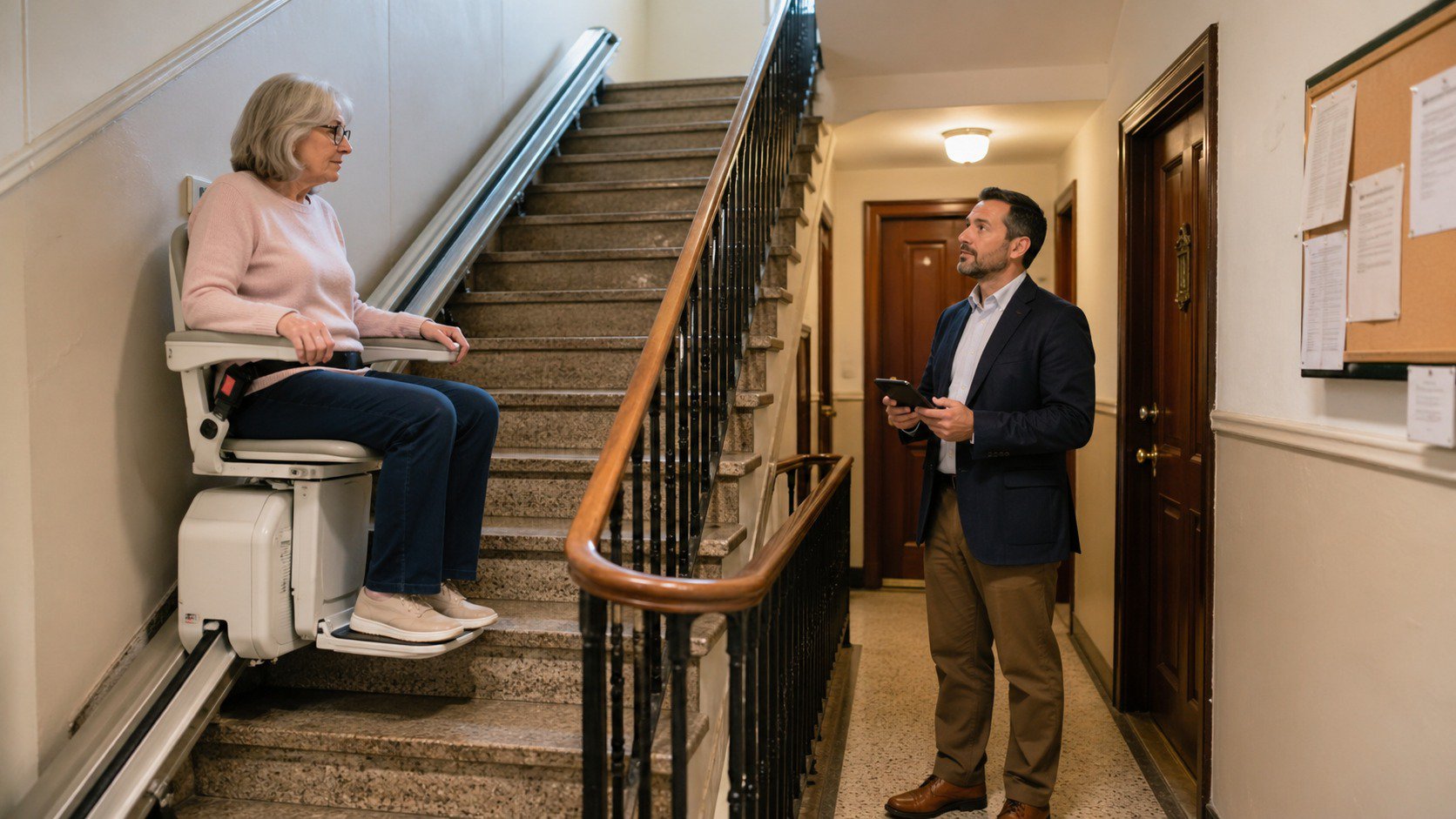
A stairlift is a motorized chair that runs along a rail mounted to the existing staircase. For ambulatory tenants who cannot manage stairs, a stairlift is the fastest, lowest-cost compliant alternative.
We install Bruno, Access BDD, and Handicare units depending on the staircase configuration. See our full stairlift brand comparison for the engineering and reliability tradeoffs:
- Straight stairlifts fit standard straight runs and can often be installed within days of an order. Bruno's Elan and Elite models cover the vast majority of NJ apartment stairwells.
- Curved stairlifts like the Handicare Freecurve are custom-fabricated to match the exact contour of staircases with turns, landings, or spiral configurations. Lead time is longer but installation in older Hudson County brownstones and Newark walk-ups is well within scope.
- Outdoor stairlifts address exterior entrance steps that present the first barrier before a tenant ever reaches an elevator.
A folded stairlift takes up about 13 inches of stair width when not in use. In most NJ apartment building stairwells, this still allows compliant egress for other tenants. Where egress width is tight, our team coordinates with your local fire marshal during the design phase.
Platform Lifts for Wheelchair Users
A stairlift requires the user to transfer from a wheelchair to a seat. For tenants who cannot transfer, a vertical platform lift (VPL) is the right answer. Platform lifts carry a full wheelchair plus rider and operate under ASME A18.1 standards.
Mobility123 installs Bruno and Savaria platform lifts in vestibules, between landings, and at building entrances. Vertical platform lifts handle straight-up vertical travel. Inclined platform lifts run along an existing staircase for buildings where vertical clearance is limited.
Platform lifts require permits, structural review, and a NJ Department of Community Affairs Elevator Safety Unit acceptance inspection. Lead times typically run four to eight weeks. For buildings with anticipated long-term elevator downtime or chronic reliability issues, a platform lift is often the most defensible compliance posture.
When You Need Both
Larger buildings with mixed-mobility tenant populations benefit from layered solutions: a stairlift in the primary stairwell for ambulatory tenants, a platform lift at the main entrance or between key floors for wheelchair users. We assess your specific tenant roster and building configuration to recommend the right combination. Our comparison guide on home elevators, homelifts, wheelchair lifts, and stairlifts walks through the tradeoffs in more detail.
A Note on Fire Code and Egress
Property managers regularly raise the same objection: will a stairlift in a shared stairwell create a fire code or egress violation? The honest answer is that it depends on three factors: the maximum occupancy of the building, the total number of staircases, and the existing staircase width.
A folded stairlift takes about 13-18 inches of stair width when not in use. NJ multifamily buildings with multiple compliant egress staircases and adequate width often accommodate a stairlift in a secondary stairwell without issue. Buildings with a single staircase, stair widths near the code minimum, or higher occupant loads require closer review, and may need an alternative such as a platform lift at the building entrance instead.
This is exactly the kind of analysis a turnkey provider performs upfront. Mobility123 reviews your specific building configuration, occupant load, and stairwell geometry against NJ Uniform Construction Code egress requirements before recommending a solution. Where the analysis points toward a code conflict, we coordinate directly with the local Bureau of Fire Safety during permit submission. A landlord working with a stairlift retailer who only sells equipment is left to figure this out alone.
Mobility123 Serves NJ Multifamily Landlords Statewide
We install across all 21 NJ counties from showrooms in Absecon (Atlantic County) and Hillsborough (Somerset County), with a construction office in Manahawkin (Ocean County).
Hudson County (Jersey City, Hoboken, Union City). Dense pre-war brownstones and converted multifamily, often with curved or narrow stairwells. Curved Flow-X stairlift installs are routine here.
Essex County (Newark, East Orange, Irvington). Older garden apartment complexes and walk-up buildings where straight Bruno stairlifts solve most of the immediate need.
Atlantic County (Atlantic City, Pleasantville, Egg Harbor Township). High-rise condo and beachfront stock with seasonal occupancy. Outdoor stairlifts at building entrances are a common fit.
Bergen and Passaic Counties. Mid-rise multifamily and converted single-family buildings. Mix of straight stairlift and platform lift work depending on entry configuration.
Central and South Jersey (Mercer, Middlesex, Camden, Burlington, Gloucester). Varied housing stock served by our statewide install crews.
If you own or manage multifamily property anywhere in New Jersey, we cover you.
Why Turnkey Project Management Is the Real Differentiator
Buying a stairlift or platform lift is the easy part. Getting one installed in a NJ multifamily building, permitted, inspected, and signed off correctly is the hard part.
Mobility123 handles the entire chain inside one team:
- Site assessment and product specification
- Permit applications (NJ DCA Elevator Safety Unit registration for platform lifts and chair lifts under NJ UCC Subchapter 12)
- Installation by factory-trained technicians, including our staff licensed elevator mechanic
- ASME A18.1 sign-off for platform lifts
- State acceptance inspection coordination
- Ongoing service and annual maintenance plans
For a landlord, this means one phone number, one quote, and one accountable owner from contract through long-term service. No managing a separate permit expediter, installer, and inspector. When something needs attention five years from now, you call the same team that installed it.
What a Free Site Assessment Looks Like
We make this easy. A typical multifamily site assessment runs 30 to 45 minutes:
- We visit your building and walk the affected stairwells, vestibules, or entries.
- We take measurements and photos.
- We discuss your tenant population and timeline.
- We provide a written quote with product recommendation, install timeline, and permit/inspection scope.
There is no obligation and no cost for the assessment. Typical timelines from approved quote to operational equipment:
- Straight stairlift in standard stairwell: 2 to 3 weeks
- Curved stairlift requiring custom rail fabrication: 6 to 10 weeks
- Vertical or inclined platform lift requiring permits: 4 to 8 weeks
Short-term coverage may also be possible. We rent indoor straight stairlifts on a short-term basis for landlords managing a major elevator repair or replacement project.
Schedule a free site assessment for your NJ multifamily property today.
Frequently Asked Questions
Does a stairlift count as an ADA-compliant alternative under pending NJ law?
The pending S3941 and A4480 bills explicitly list "motorized stairlifts" as an example of an acceptable ADA-compliant alternative when an elevator goes out of service in a multistory building. Existing federal ADA and FHA frameworks treat stairlifts and platform lifts as reasonable accommodations when properly installed and maintained. Note that stairlifts alone are not ADA compliant.
How quickly can a stairlift be installed in an apartment building stairwell?
A standard straight stairlift can typically be installed within 1-week of an approved quote. In urgent situations, Mobility123 keeps inventory in stock and can sometimes install in less than a week. Curved stairlifts or platform lifts requiring custom fabrication or permitting take longer. This time can vary depending on the local municipality and permit timelines.
Will a stairlift in a shared stairwell violate fire code or block egress?
It depends, and the answer is rarely black and white. Whether a stairlift can be installed in a shared stairwell turns on the specific building's maximum occupancy, the number of compliant egress stairs, the actual stair width, and how the local Authority Having Jurisdiction interprets the applicable NJ Uniform Construction Code provisions. A folded stairlift typically occupies about 13-16 inches of stair width, which works in some configurations and not in others. Even buildings that look similar on paper can land differently depending on which code edition the municipality has adopted, how the local Bureau of Fire Safety reviews the permit, and the specifics of the egress calculation for that occupancy. Mobility123 evaluates your specific building, runs the egress math, and engages the local AHJ during permitting before committing to an approach. Where the stairwell route does not work, we recommend a platform lift at the entrance or another alternative.
Who is responsible for maintenance and inspection after installation?
Mobility123 offers maintenance plans covering annual or bi-annual service visits, parts and labor coverage, and priority scheduling. Commercial platform lifts also require annual state inspections in NJ, which our service team can coordinate directly with the DCA Elevator Safety Unit. See our general stairlift FAQ for additional information.
Can stairlifts be rented short-term during a major elevator repair?
Yes. Mobility123 rents indoor straight stairlifts on a short-term basis. This is a common solution for landlords managing a multi-week elevator modernization or repair project who need to maintain compliant access during the work. The permit process can take some time, so better to get started asap.
Schedule Your Free Site Assessment
Pending NJ legislation, existing federal exposure, and active state civil rights law all point in the same direction: every multistory NJ landlord needs an elevator outage backup plan, and the cheapest plan is one that is already in place before the elevator fails.
Mobility123 has been installing stairlifts, platform lifts, and home elevators across New Jersey since 2003. We are family-owned, NJ-based, and licensed. Schedule a free site assessment today and we will design a compliance solution tailored to your building.
